Graham McAllister for Edge Magazine:

For many gamers, it’s more likely that they will stop playing at the end of a level rather than in the middle of a level. However, in Game Dev Story, the end of a level is somewhat blurred, as once your game in development is complete, rather than be rewarded with the sales figures immediately, you have period of time where you see your game’s sales figures gradually increase. You’re not inactive, however, because you’ll be taking on contract jobs or starting another game development project so your staff don’t lie fallow, effectively starting a second game loop before the first has finished. This overlap in game loops removes a natural exit point from the game, making it much more likely that you’ll continue to play. Forever.

Game Dev Story ate up a lot of late night time for about a week for me, and it is very cleverly designed in this way. You are constantly being given new tasks to do and it’s not clear when they will end.

It also helps that the game has a ton of charm and even intentional occurrences of “Engrish.”

You can pick it up for iOS here if you are interested in seeing what this looks like. It’s $4 well spent.

SlashGear in proclaiming the death of the 3DS:

Unlike its predecessors, the 3DS is facing a slew of issues. For one, the 3D effect falls short for many folks, and after a while, it becomes more like a gimmick than an integral part of the gaming experience. What’s more, the 3DS’ lack of compelling games (which Nintendo says, will be addressed by the end of this year, thanks to Super Mario 3D Land), is holding it back.

But I think it goes beyond that. The 3DS is failing right now, more than any other reason, because of smartphones and tablets offering compelling gaming experiences. And when the iPhone 5 launches in the next several weeks, you can expect it to officially kill off the 3DS.

This isn’t the only thing I’ve read discussing the quandary that Nintendo finds itself in. Example: Tycho in yesterday’s Penny Arcade post, discussing the battery life of the upcoming PlayStation Vita:

This isn’t just true of the Vita, of course, this battery stuff; if anyone actually played their 3DS for any length of time, I suspect they’d come away similarly despondent, pressing buttons which don’t do anything and looking at a screen which is connected to nothing.

This is that “portability” thing when we talk about a “portable” gaming system.  Portability means more than the ability to carry something or stow it on your person.  Obviously, the word doesn’t mean that – it’s not bound up in the roots.  But the implication is that something may be carried and still retain its function.  Right?  Right.  This isn’t really a philosophical distinction, it’s not hair-splitting for dialectic giggles.  A portable without robust power storage is not.

Handheld gaming is facing tough challenges on multiple fronts at the moment. I’m increasingly finding myself choosing to play portable games on my iPhone or iPad. I’ll go so far as to know I’m going out somewhere where I will have time, look at my DS, pick it up, and then put it back down as I decide it’s not worth the time.

The PSP was arguably always a failure; it failed to capture a solid market and was a product that never seemed to find decent footing. But the DS was one of the most successful game consoles in history, with a ridiculous sell-through and a strong appeal to the casual market as well as great long-form experiences (it’s a great platform to find quality JRPG experiences and 2d platformers). Nintendo sold through no less than four revisions of basically the same hardware—which I believe is also contributing to the market resistance to the 3DS.

Satoru Iwata believes the 3DS has a future, at least officially in response to calls for Nintendo to embrace smartphone development:

“This is absolutely not under consideration,” he said. “If we did this, Nintendo would cease to be Nintendo. Having a hardware development team in-house is a major strength. It’s the duty of management to make use of those strengths.

“It’s probably the correct decision in the sense that the moment we started to release games on smartphones we’d make profits. However, I believe my responsibility is not to short-term profits, but to Nintendo’s mid- and long-term competitive strength.”

Keep in mind that this is after the Nintendo showcase at TGS, traditionally their marquee event, caused a market reaction that sent Nintendo’s stock tumbling 5%.

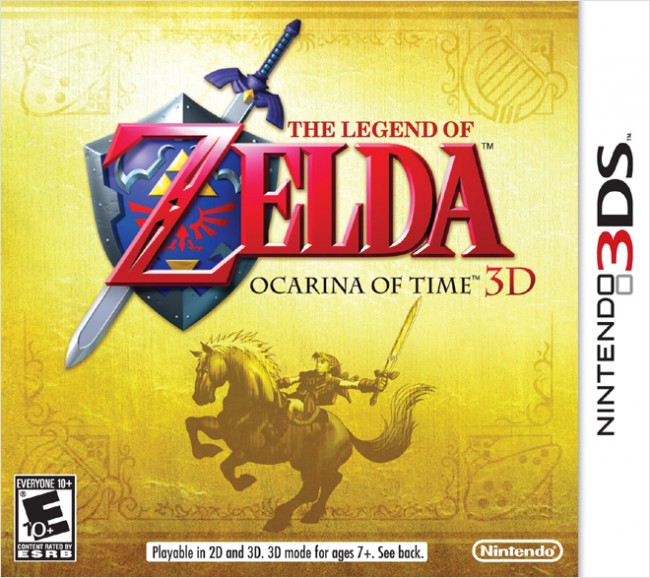
For me, it boils down to the following: for $40, I can have this copy of a remake (a remake!) of perhaps the best game of all time:
For about 60 bucks (not counting buying things on sale), I can have this:

And I don’t have to go to a GameStop or similarly annoying store to buy them; I just load up the App Store, make the purchase, and download it. Some of the games on this list have provided me with longer experiences than many DS games, and certainly a better value proposition in the long-term.

This doesn’t even approach the added value of the iPad being my salvation from airplane movie selections (look; an entire TV season in my backpack!), or the fact that I do a majority of my web reading on this device (I found the articles linked in this post using various apps on my iPad). Or the fact that the same experiences are available on the phone I already have with me anyway, or that both devices have at least double the battery life (in the case of iPad, more like triple or better).

There’s a value train that left the station a while back, and Nintendo is not on board. I love Nintendo and the minds they have there designing interactive experiences. Their games were a special part of my childhood. I don’t want them to fail, and I don’t want to miss out on what they are doing (which will likely lead to my purchasing whatever the rev 2 hardware is for 3DS).

Sony finds themselves in a similar situation; an over-designed piece of hardware that will likely have compelling games but a like pricing structure and comparable challenges ahead. The Vita is sure to be impressive and looks good on paper.

But unfortunately for both those companies my money is better spent on iOS.

A pleasant little surprise today in the form of a great update to a fantastic game:

In this very first update we’ve added some awesome goodies for you to try!

MR. CUDDLES – This is a new vehicle pickup that will appear during the course of your normal game – and it’s a giant fire-breathing robot dragon!

You’re my new best friend, Mr. Cuddles.

If you don’t have this game, you should probably take care of that problem.

Go Make Me a Sandwich:

Even now that the afterglow of having finished my first ME2 playthrough has faded (at least as much as it’s ever going to), the Lair of the Shadow Broker DLC remains one of my favorite parts of the game. Liara is an awesome, competent, not-sexualized female character who has her own agenda – which is exactly what I have been asking for by writing this blog. I can’t emphasize how important the not-sexualized aspect of that is, either.

[…]

So what happened? Were your male fans upset that Liara wasn’t sexy enough? Because I just don’t understand this blatant pandering. Even after you said that FemShep would only be on the collector’s edition cover of ME3, I was still encouraged and elated that you were making such a step at all. You’ve been talking with your fans this time around – letting us choose the FemShep we wanted on the cover, promising a FemShep trailer… It made me think that you were maybe, finally turning over a new leaf.

Agreed 100%. After Bioware somehow managed to transform the “oh, I’m so naĂŻve and lacking confidence and need a big strong Shepard Skywalker to rescue me” Liara from ME1 into a strong, moderately complex and mysterious badass, making this figure is a mistake.

A good first start for talking about how to play or watch a game is to begin with speaking of how you win said game. The objective of the game of baseball is deceptively simple:

At the end of nine innings, the team that has scored more runs is the winner.

This is a simple concept for those who have followed baseball for years, but for someone new to the game, I have just introduced three new concepts in that one sentence. We’ll break things down even more over time, but to help you in your understanding of how a game is won, the best place to start is to also teach you how to read the line score.

An Example Line Score and How to Read It

The best example is a real one. Here’s the completed line score as seen on from a game between the St. Louis Cardinals and the Chicago Cubs, played in St. Louis:

A few notes about how the line score is composed:

  • The home team (the team in whose city the game is played) is always at the bottom half of the line score. This is not merely cosmetic; the home team is granted an advantage in the game by batting last in each inning.
  • At the right end of the line score is the running total for the three basic stats for each team in the game. These are:
    • Runs, which are the only scoring tally in baseball and were discussed in the game objective above. A run is scored when a batter successfully reaches each of the four bases in succession and touches home plate,
    • Hits, which are recorded when a batter strikes the ball with his bat and successfully reaches base before being put out, and
    • Errors, which are officially recorded defensive mistakes where an out should have been made with what is termed “ordinary effort” but the defensive player did not succeed.
  • Some line scores will include a running total labeled LOB, which indicates runners who were left on base (or “stranded”) by reaching base but not touching home plate before the end of their team’s offensive half of an inning.
  • The remainder of the line score is broken into a grid that shows the number of runs scored in each half-inning. The game starts at the top of the first inning and proceeds from there.
  • In this line score, you can see that St. Louis won the game, with the final score being six to one.

Innings

A game of baseball is broken into nine innings. Each inning has a top and a bottom, according to the place in the line score. I’ll put the line score back up so you can see that again:

In the top half of each inning, the visiting team plays offense and the home team plays defense. This continues until the defense records three outs, which is called retiring the side.

After the third out, the teams switch sides and play the bottom half of the inning, likewise until three outs are recorded. The home team plays offense in the bottom half of all innings to give them an advantage, especially in later innings.

As an example, look at the fifth inning in this line score.

In the top of the fifth, the Cubs scored one run before their three outs, and the Cardinals scored two runs in the bottom of the fifth before their three outs.

(We’ll talk more about how outs work later.)

Note that there’s no clock in baseball of any kind. A team is permitted to continue their half of a given inning until three of their players are put out. There’s no limit to the number of batters who come up in a half-inning, and no rule placing a maximum on the number of runs that can be scored.

Two things to note about innings and how they work:

  • If a game is tied at the end of the ninth inning, additional innings are added to the end of the game until there is a winner. Both halves of the inning are always played to give the home team the chance to answer any leads by the visiting team. This is called extra innings.
  • If the home team has more runs after the top of the ninth inning, the bottom half of the ninth inning is not played. You can see this in the box score above, being marked with an “X”. Similarly, if the home team scores to take the lead at any point in the bottom of the ninth inning or in the bottom of any extra inning, the game immediately ends when that run scores (since there is no point in continuing play).

The Basics

What you’ve read here is the minimum necessary to understand how the game is scored and how your team wins the game. In future posts, I’ll cover more of the concepts listed here, such as how an out is made, how runs are scored, and how teams play offense and defense.

If you have any questions, please leave a comment. I’ll be happy to answer them for you.

Good sight-reads (includes one track that was released in the first pack but I hadn’t cleared in RB3 yet). :) Chord-heavy, but generally fun to play and some decent challenge in there with the patterns.

Maroon 5 is one of those bands I enjoy listening to for reasons that aren’t quite clear even to me. I was happy to see some more tracks in the Music Store.

For lots of Americans, the game of baseball is something that has deep cultural and family connections. For people like myself, my father, and my children, we have grown up listening to and watching baseball, both in person and through various media. Because of this, lots of Americans have an ingrained understanding of the game, the rules, and the various complexities behind it.

Baseball is, as a game, very interesting and rich in strategy and statistical depth. You can watch it and follow it on many different levels.

But what if you haven’t been steeped in this American tradition? What if you come from lands distant, or if you had never seen a baseball game? Are you going to a game for the first time? Are you interested in learning about another sport, one with a storied history and tradition? Are you marrying someone who is a baseball super-fan but you don’t know the first thing about a foul ball, a bunt, or an infield fly?

The following posts are for you. In them, I’ll try to explain the basics of baseball, then moving into more complex aspects of the game, using “real” language and images whenever possible to highlight specific things about the game. It can be difficult to get a handle on the game at first, as many of the rules and concepts are inter-related. It’s hard to know where to start.

If, as you read, and as I write these posts, you have questions or you feel confused, please feel free to add a comment and ask your question or suggest an additional post. I will do what I can to build on this guide based on the needs of its readers.

I’ve added a link in the navigation for this site for these posts; I’ll also try to update this lead post with a table of contents of sorts to try and keep things organized.